WTF is a Sagulator? I wish I'd known before I built my kitchen.
I planned our kitchen around an American fridge freezer. When my little one's Abuela comes round, she fills that fridge and cooks up a storm, and I wanted room for every bit of it.
I designed the kitchen with DIY Kitchens, and I loved it. They are amazing. I designed the fridge box and fitted it myself, and I was proud of it.
Over the fridge sits a bridging unit, a cabinet that spans the gap between the two tall housing panels round the fridge. Mine is 920 mm wide and 300 mm deep, with a bottom of 18 mm melamine-faced chipboard, and we keep things in it. Quite soon after I fitted it, that bottom started to sag. You can see the dip in the photo, where I drew a purple line along its bottom edge.
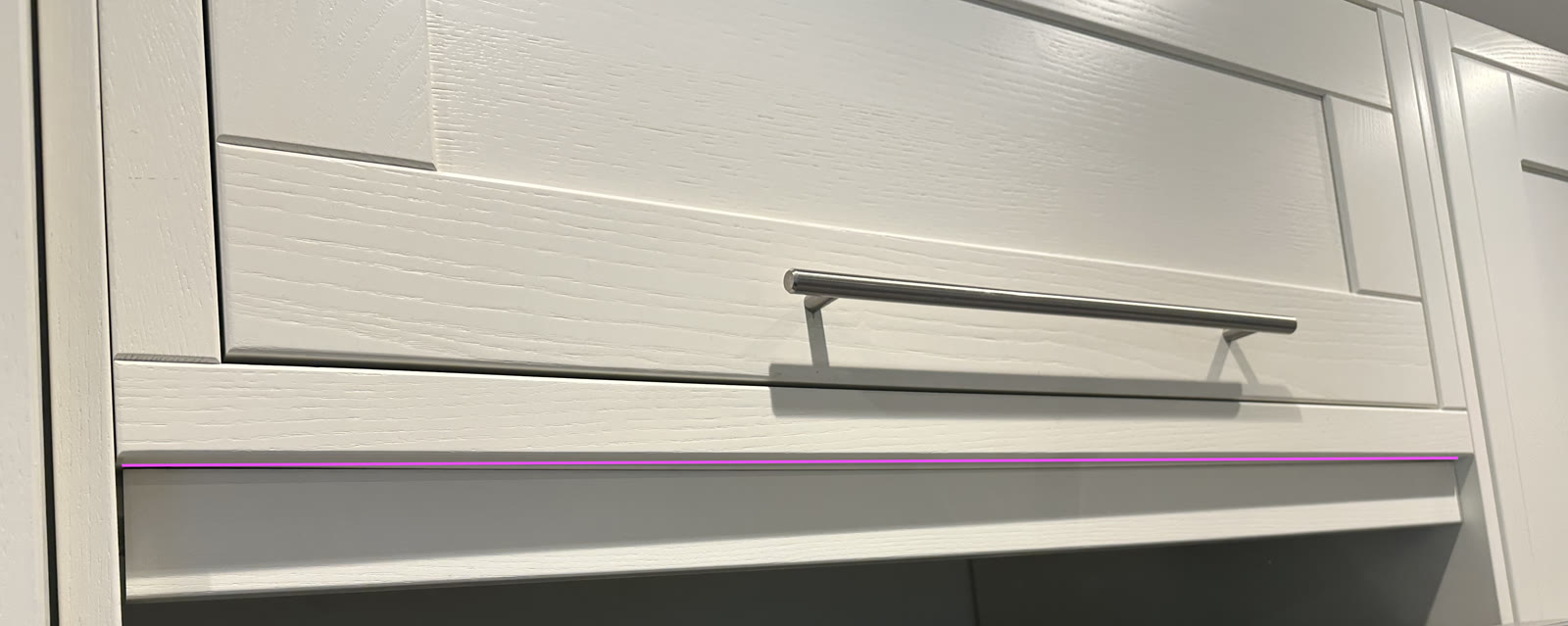
Luckily, I had a spare pelmet, the trim strip that runs under wall cabinets, so I fixed it underneath to stiffen the unit. Two years on, you can still see it starting to sag a little, and I'll have to find a better way to hold it up.
I'd never heard of a Sagulator#
Back then, I had never heard of a Sagulator. Later, I found out about Sagulator calculations, and I love the name. It's a weird word for something useful: a free calculator on woodbin.com that tells you how far a shelf will sag before you build it. Hat tip to WoodBin for giving it away.
You give it the board, the distance between its supports and the load, and it gives you the sag. It also warns that wood shelves "will sag an additional 50% over time beyond the initial deflection". So a shelf that looks straight on the day you fill it can keep bending for years, which is what mine is still doing.
Seasoned woodworkers know tools like it. Someone building their first kitchen, or their first shelves, doesn't know to look.
What I didn't know to ask#
When you make things yourself, you think about how they look, what they hold and how they fit. You don't always know in advance what else you should think about. I never asked how far an 18 mm board would sag across 920 mm, or how much more it would sag in a few years. And the bridging unit came from DIY Kitchens as a ready-made carcass.
You can't know what you don't know. So the tool you design with, and any agent that uses it, has to ask those questions for you. It also has to be precise enough that you can trust the answer.
If you design a beautiful shelf or kitchen unit, or buy one, you'd be disappointed to see it sag. A design that looks right isn't enough. The tool has to check that the thing will work: the load, the years and the way it is held up.
Makers, enthusiasts, professionals and agents all need to trust the tool. That trust comes from the detail and precision behind each check.
What KerfCraft does now#
When I found out about Sagulator calculations, I built them into KerfCraft. Then I took them further. The Sagulator is a great starting point, a loved free tool, and it opened my eyes. But it calculates shelves one at a time, from the sizes and loads you give it.
KerfCraft does more, and it does it by itself as you or the assistant design:
- It reads how each shelf in your design is held: at both ends, along the back too, resting or fixed down.
- It counts the shelf's own weight and the slow bending of years.
- It estimates the furniture standards' shelf tests.
- It suggests fixes, and checks each one again.
Here is a unit like mine in KerfCraft: 920 mm wide, 300 mm deep, in 18 mm white melamine-faced chipboard, with nothing under it.
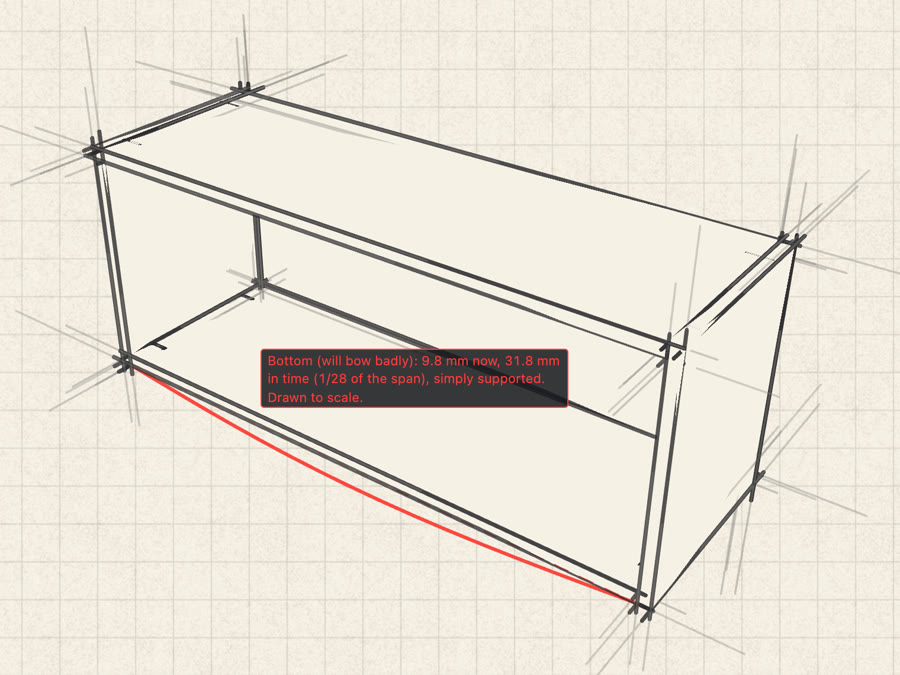
Say it holds crockery, at KerfCraft's Kitchen crockery load of 25 kg on each metre. That load is only an example, not what we really keep in ours. KerfCraft estimates that the bottom will bow badly, by 9.8 mm as soon as the plates go in and 31.8 mm in time. That is what it would have told me before I built mine.
For a unit like mine, a support in the middle of the bottom cuts the sag in time to 1.3 mm. That is a big improvement, but still visible sag: KerfCraft's line for fine is stricter. A thicker chipboard bottom isn't enough on its own, so KerfCraft suggests a thicker one together with a support.
Tipping came first: KerfCraft estimates whether a tall unit will tip, as Will it tip? explains. Shelf sag came next, and there is more to come.
The assistant works the same way. When it designs shelves for you, it asks what they will hold if you haven't said, and checks them for sag as it goes. When it builds a tall unit, it checks whether the unit could tip.
If a shelf is held only at one end or along one edge, the assistant fixes that itself before it hands the design over. For a shelf that sags or a unit that could tip, it tells you the first fix, and you choose what to change.
If you'd like to try it on a shelf of your own, Check a shelf for sag shows you how. For the details, read Why a back batten can make a plywood shelf sag more.
A design has to survive the real world. I'm building KerfCraft so that people can design furniture they will actually build, love, and use for years, and perhaps even hand down through generations.