Will it tip?
You have drawn a wardrobe. The doors line up and the cut list is ready. Before you buy a sheet of plywood, ask one plain question: will it tip?
The worry is real. From 2013 to July 2023, the US Consumer Product Safety Commission had reports of 217 deaths from furniture, TVs and appliances tipping over. 155 of them were children under 18.
You can estimate the answer before you build, with a sum you can do on the back of an envelope.
Why furniture tips#
A wardrobe tips forward, over the front edge of whatever it stands on. As it falls, it turns about that edge. Think of it as an imaginary hinge along the floor, not the hinges on the doors. We call it the tipping edge.
The wardrobe's own weight pulls straight down through its centre of gravity, a little behind the tipping edge. That holds it back. Anything that pulls or hangs out in front of the tipping edge tries to swing it over. Whichever turns harder wins.
The turning effect of a force is the force times its distance from the tipping edge, like pushing on a spanner. Push twice as far along the handle and you get twice the turn. Engineers call it a moment, and measure it in newton metres (N·m).
A 500 mm wardrobe#
Take a standard two-door wardrobe, 2.1 m tall and 1.2 m wide, but make it 500 mm deep. Here is how hard it is to tip, worked out below:
- Doors shut: a horizontal pull of about 140 N at the top, as much force as the weight of 14 kg.
- Every door and drawer open, on a hard floor: about 25 kg hanging on the top of an open door.
- Open, on carpet: about 19 kg on the door.
These are estimates from a drawing, not results from a test lab.
Doors shut#
Add up each part's weight from its size and the board's density. We drew it in 18 mm birch plywood, with 6 mm backs and 12 mm drawer boxes. We used about 710 kg/m³, the figure for birch plywood in the Eurocode for loads on structures (EN 1991-1-1).
The carcass comes to about 82 kg, the doors 31 kg, the shelves and rail 22 kg, and the two drawers 10 kg. That is 145 kg empty, without the hinges and runners.
The centre of gravity is the average position of all that weight. Here it is about 1 m up and 204 mm behind the tipping edge. 145 kg weighs 145 × 9.81 = 1,420 N, so it holds the wardrobe back with 1,420 × 0.204 = about 290 N·m. To tip it with the doors shut, you would pull its top, 2.1 m up, with 290 ÷ 2.1 = about 140 N.
Open the doors#
Now open the doors and pull out the drawers. They swing and slide out past the tipping edge, so their weight pulls the wrong way. The open doors and drawers turn it forward with about 123 N·m, and the rest holds it back with 275. That leaves about 152 N·m holding it up, barely half of what it had shut.
Each door is about 600 mm wide. Open at right angles, its outer edge sticks out 615 mm in front of the tipping edge. Weight hung there has a long lever. On a hard, flat floor, 152 ÷ (9.81 × 0.615) = about 25 kg tips it.
On carpet#
Carpet leans a wardrobe forward a little. The US safety test (more on it below) simulates that with a 0.43 in (10.9 mm) block under the back. With the front and back supports 500 mm apart, that is a lean of about 1.25°.
At that lean, everything moves forward by about 22 mm for every metre it is off the floor. The centre of gravity comes closer to the tipping edge, so what holds it back drops to about 121 N·m. The top of the door moves out to 661 mm. Now 121 ÷ (9.81 × 0.661) = about 19 kg on the top of the open door tips it.
This sum hangs the weight at the door's outer top corner. The real test's weight acts a little further in, which gives roughly 20 kg here. Either way, it tips well below the test's 27.2 kg.
For a wardrobe that is mostly hanging space, empty is an important case to check. Clothes on the rail and shelves sit behind the tipping edge and help hold it back. Heavy things in an open drawer, or hanging on an open door, do the opposite.
It is only an estimate#
Every figure here comes from the drawing. The wood you buy will not match it exactly.
- The board: birch plywood differs from supplier to supplier, and from sheet to sheet. Our 710 kg/m³ is a book figure, not a weighed sheet.
- The build: a solid oak door, a thicker back or a missing shelf moves the weight. So do the hinges, runners and handles, which we left out.
- The fit: feet, plinths and floors are never perfectly flat or square, and parts are cut to a tolerance.
One rule of thumb helps. If every modelled part is lighter than drawn, every "kilos to tip it" figure drops by about the same share. Sheets 10 % lighter than the book figure turn 19 kg into about 17 kg. So draw it as you will build it, and leave a margin.
What the law tests#
In the US, the STURDY Act made a standard, ASTM F2057-23, law. Clothes storage made after 1 September 2023 for the US market must meet it.
The rule covers freestanding units at least 686 mm (27 in) tall and 13.6 kg (30 lb) heavy. They need 90.6 litres (3.2 ft³) of enclosed storage.
Built-in units, bookcases and shelving are out of its scope.
The tests run without any wall fixing, with the doors and drawers opened as the standard says:
- Clothes: if at least half the calculated storage volume is extended, weights are added to simulate clothes. Otherwise the unit is tested empty. This wardrobe's two small drawers are well under half.
- A tug: a 10 lb (44.5 N) pull straight towards you. It goes on the handle or drawer most likely to tip it, no higher than 56 in (1,422 mm).
- A child: 60 lb (27.2 kg) hanging from the top of the open door or drawer most likely to tip it, on the carpet block.
Even if we apply the full 44.5 N at 1,422 mm, the tug turns our wardrobe with only about 63 N·m, against 152 N·m. The child is the problem. By our sums, 19 kg tips it, so it would tip under the test's 27.2 kg. The units sold there must also come with an anti-tip device.
In the UK and Europe, the stability tests for home storage furniture are in a standard, BS EN 14749. They include opening every door and drawer with the unit empty, and tests with added loads. The tests differ from the US ones, so passing one does not mean passing the other. A standard is not a law in itself, but UK law asks for safe products, and the standard is how a seller shows it.
These rules for selling furniture generally do not apply to furniture you build for your own use. The risk does, though, and the US child test is a demanding case for a wardrobe like this one.
What if we make it 600 mm deep?#
Now make the wardrobe 600 mm deep. By our sums it takes about 35 kg on the door to tip it. That is 28 % above the 27.2 kg the test hangs, so our model predicts it would pass, with a calculated 28 % to spare.
But carpets vary. In CPSC research, furniture on carpet behaved as if it leaned forward by anything from 0.8° to 3°. Under this deeper wardrobe, the block gives only 1°. At 3°, about 24 kg tips it.
So the extra 100 mm of depth helps, but it does not make the wardrobe safe on every floor. That is why we check 3° as well as the block, and want at least 20 % to spare on the law's tests. The 20 % is our own rule of thumb, for the estimates above.
Why you still fix it to the wall#
A strap or bracket near the top of the wardrobe has a long lever, so even a modest pull helps it resist tipping. But the force it takes depends on what is in the wardrobe, how a child moves on it, and how the strap is fitted.
Sums like the ones above cannot tell you what size of screw or bracket is safe. Use a tested anti-tip kit and follow its instructions. Screw it into the wardrobe's solid top, not the thin back, and into a stud, or into masonry with the right plug.
No depth or weight makes a tall wardrobe safe in every room. Open drawers, uneven floors and climbing children all change the sums.
The US safety agency's Anchor It! campaign has more on fixing furniture to the wall safely.
Check your design in KerfCraft#
KerfCraft estimates the three US stability tests and the 3° check from your drawing. To try it on the wardrobe from this post:
- Select File ▸ New ▸ Wardrobe….
- At Depth (mm), type
500. - Click Create.
- Above the 3D view, click ⋯, then click Weight and tipping.
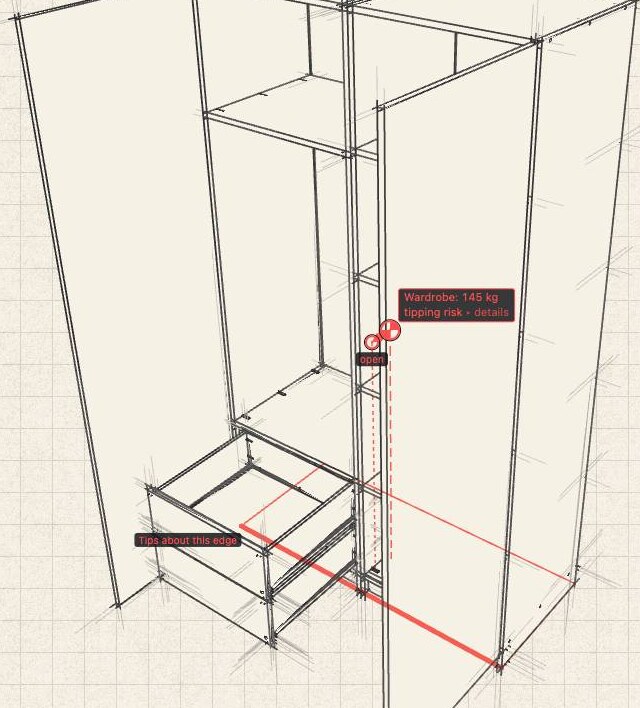
A red line along the front of the base marks the tipping edge. The marker shows the centre of gravity with the doors shut, and a hollow one shows where it moves with everything open. Click the marker to see each test worked out.
The marker's colour sums up the estimate:
- Red, "tipping risk": by our sums, it tips in one of the law's tests.
- Amber, "close to tipping": it passes them, but tips at 3° or has less than 20 % to spare.
- Green, "checks passed": it passes the calculated checks. Fix tall furniture to the wall anyway.
KerfCraft cannot see screws. A part named "Anti-tip bracket", touching the unit, makes the marker read "anti-tip fixing drawn". That only means a fixing is drawn. It is not proof of its strength. Check a unit for tipping and weight has the details.