Why a back batten can make a plywood shelf sag more
KerfCraft's shelf check estimates how far a shelf sags when you load it, and how much more it sags after years. This post explains how the check works, with the numbers from the app.
The Sagulator and WoodBin's measurements#
The Sagulator is a free shelf calculator on woodbin.com. Hat tip to WoodBin: its notes and its shop measurements helped shape KerfCraft's check. It "employs established engineering formulas for calculating beam deflection": the textbook sum for how far a board bends between two supports. It also warns that wood shelves "will sag an additional 50% over time beyond the initial deflection".
The Sagulator has two ways to hold a shelf: fixed to its sides, or floating. In its sum, a fixed end can't turn at all. That makes a shelf five times stiffer than one that rests on its ends.
WoodBin also measured real shelves with a gauge they built. For shelves fixed to their sides, with no edging strip, the readings were "approximately 2.5 to 3.5 times greater than the calculated values". So KerfCraft treats every shelf end as resting on its support. A shelf screwed or housed into its sides can sag less, depending on how stiff the joint is.
We test KerfCraft's check against one of WoodBin's readings. Each reading starts with the shelf already on its supports, so the shelf's own weight is left out. For a ¾ in poplar shelf on supports 48 in apart, with 30 lb on each foot of its length, WoodBin measured 0.24 in. KerfCraft's check, also without the shelf's weight, gives 0.26 in, about 10 % more.
A plate, not a beam#
The beam sum knows only the two end supports. KerfCraft treats a shelf as a plate, a board held along its edges, so it can count a batten along the back. That gave us a surprise.
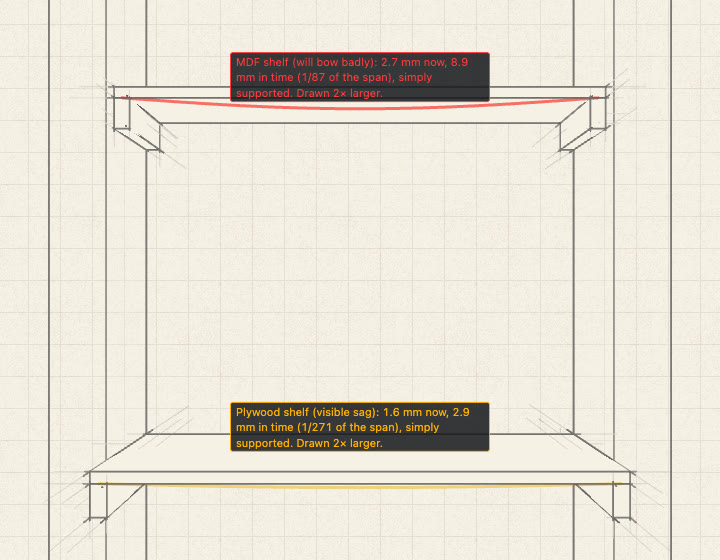
Take an alcove 800 mm wide, with two shelves on end battens: strips of wood fixed to the side walls. The top shelf is 18 mm MDF (fibreboard), 250 mm deep, with paperbacks. The bottom shelf is 18 mm birch plywood, 400 mm deep, with vinyl records.
Drawn 2× larger.
In time, the MDF shelf sags 8.9 mm and the plywood shelf 2.9 mm. Now add a batten under the back edge of each shelf.
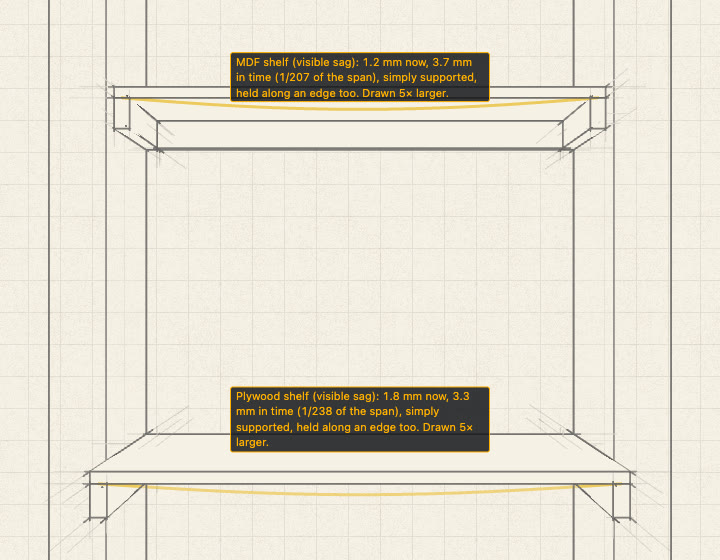
Drawn 5× larger.
The MDF shelf now sags 3.7 mm in time, less than half as much. The plywood shelf sags more: 3.3 mm instead of 2.9 mm. KerfCraft suggests a cleat, a batten screwed under the back edge, only when it helps the shelf.
Why the batten makes a deep plywood shelf sag more#
This is a calculated result: plate theory, checked against published plate tables, not a shelf we measured.
On its two end battens, the shelf bends along its length, and its front and back edges sag about the same. A batten under the back stops the back edge from dropping. So the shelf now also bends from front to back.
Picture one strip of the shelf, from the back batten to the front edge. The batten is like a hinge at its back. Along the rest of its length, the shelf bending between the end battens holds the strip up, like springs under it.
With a hinge at the back, the strip has to balance about it, like a seesaw. The springs near the back now push up less, so the springs near the front must push up more. So the front sinks further.
What stops this is twisting stiffness: how hard the board is to twist. It ties the middle of the shelf to its ends, where it cannot tip. MDF's stiffness in twisting is about a quarter of its stiffness in bending. Birch plywood's is only about a sixteenth, so a deep plywood shelf tips more about the batten.
These are the numbers from the app, for 18 mm boards on end battens 775 mm apart, holding vinyl records:
- Birch plywood, 400 mm deep: 2.86 mm in time on its ends, 3.25 mm with a back batten it rests on, 3.23 mm screwed down.
- Birch plywood, 250 mm deep: the batten helps, from 4.42 mm to 3.88 mm.
- MDF, 400 mm deep: the batten helps a lot, from 23.8 mm to 16.0 mm.
In the same sums, plywood that resisted twisting as well as MDF would sag about a third less at the front with the batten. All of this holds when the shelf can turn on the batten. If the back edge cannot turn, the batten helps a lot: the front of the 400 mm plywood shelf then sags about half as much.
Creep: the slow part#
Wood and boards keep bending, slowly, under a load that stays. This is creep. KerfCraft takes its creep factors from Eurocode 5, the European standard for timber design.
Plywood's sag in time is its first sag × 1.8. Solid wood's is × 1.6, close to the Sagulator's 50 %. MDF's and chipboard's is × 3.25, one reason the MDF shelf above did badly.
Check a bookcase#
- Select File ▸ New ▸ Bookcase….
- At Width (mm), type
1200. - At Shelves hold, select Hardback and reference books.
- Click Create.
- Above the 3D view, click ⋯, then click Shelf sag.
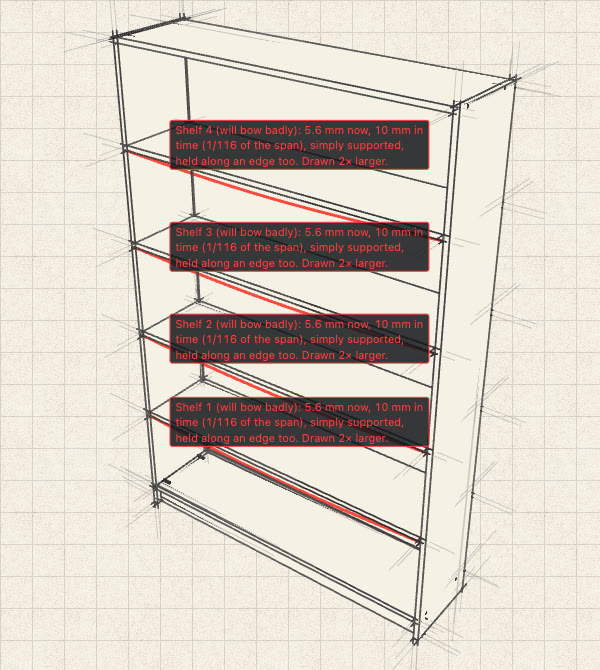
Drawn 2× larger.
Every label is red: each 1162 mm shelf of 18 mm birch plywood will bow badly, 5.6 mm now and 10 mm in time. The books weigh 30 kg on each metre, and the check adds the shelf's own 4.4 kg.
The colours follow two limits. Green is fine: at most 1/400 of the span in time, just less than the eye notices. Amber is visible sag, up to 1/200 of the span, the shelf limit in EN 16121, a European furniture standard.
Beyond that, red means the shelf will bow badly. These shelves sag 1/116 of their span.
The second fix that KerfCraft lists for these shelves is a centre support:
- In the Model panel, click Bookcase.
- In the Layout grid, click A1.
- Click Split into columns.
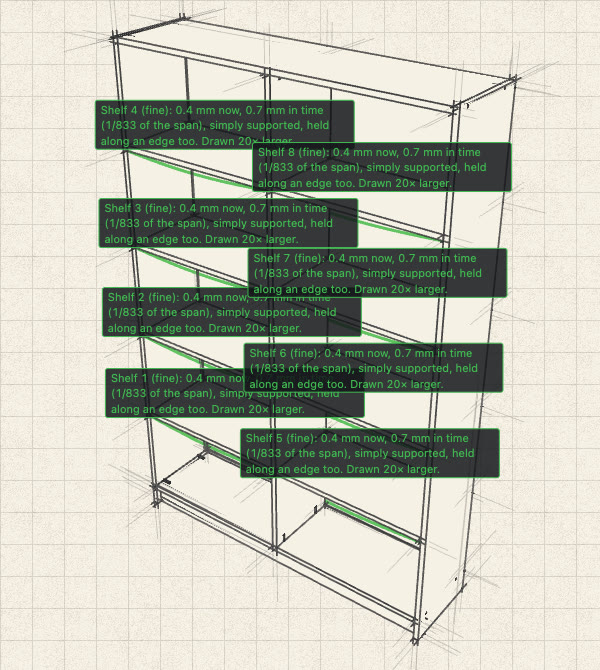
Drawn 20× larger.
Each shelf is now 571 mm long, and every label turns green: 0.4 mm now and 0.7 mm in time. Halving the span cut the sag in time from 10 mm to 0.7 mm. In the beam sum, the sag grows with the span to the fourth power, so half the span gives about a sixteenth of the sag.
The furniture standards' shelf tests#
KerfCraft estimates the furniture standards' shelf tests from your model. Open the Cut list tab. Below the cut list, find a shelf's line and click Fixes, shelf tests and assumptions.

Each test says in plain words what it puts on your shelf. "Home furniture: 1 kg on each 10 × 10 cm of shelf, for one week. On this shelf that is 34.2 kg."
For home furniture, the 1200 mm bookcase shelf is amber: within the limit when loaded, over it with the creep of years. It is red for kitchens and offices, and amber for US kitchen cabinets. You choose the test for your type of unit.
The assistant runs the same check#
When the assistant designs shelves and you haven't said what they hold, it asks, or tells you what it assumed. It runs the same check as it designs. For each shelf that isn't fine, it gives the sag in time and the first fix.
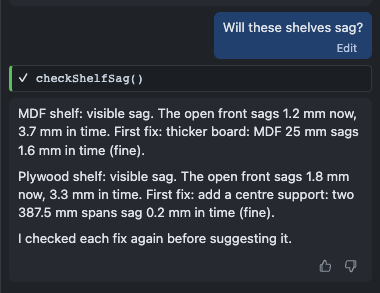
An illustration of the assistant's answer.
Next: Check a shelf for sag shows how to set what a shelf holds.